
Types of Singing Bowls
Jambati
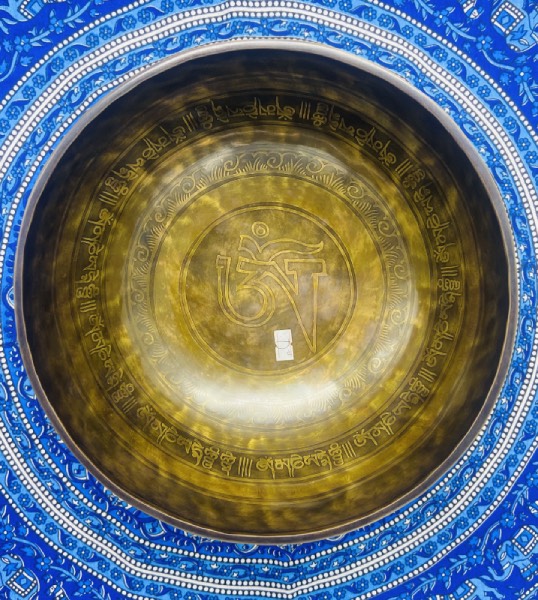
Jambati Singing Bowls are characterized by attractive hammer markings that arise by the forging process. They are the most beautiful bowl. Jambati Singing Bowls have quite high and curved walls, flat bottom and inward facing-lip. Older bowls have itching lines just below the outer rim and circular markings inside at the bottom. They have become rare in recent years. However, new Jambati Singing Bowls do not necessarily have an outer line. They look simpler yet attractive. Jambati Singing Bowls produce wonderful tones with a long sustain.
Jambati Bowls have vibrational notes that range from 2nd to 4th octaves. Jambati Bowls are used in therapy, healing and meditation as well in chakra cleansing, balancing, purification and sound bath.
Thadobati
The word "Thado" means straight. Thadobati is singing bowls with vertical sides and a flat bottom. Their walls can be thor thin and are certainly deep. The lips of Thadobati Singing Bowl are plain and thin. Thadobati Singing Bowls are the most ancient common singing bowls. They date back well over 500 years. Very few Thadobati Singing Bowls come with decorative markings.
These bowls have wonderful pleasing voices. The vibration range in tone over the 4th octave, though smaller bowls can go up to the 6th octave, while larger bowls have a low octave to 3rd.
Ultabati
Ultabati Singing Bowls are Jambati like bowls with curves in their rims. They have smaller itching marks like Jambati bowls Ultabai Singing Bowls have prominent hammer marks with black and darkened outside walls and bright interiors.
They produce low tone same as Jambati bowls. When they are played produce the lowest octaves 2. When they are hit by the mallet produce a humming "OM" sound.
Naga or Pedestal
All other singing bowls are one solid piece but Naga or Pedestal Singing Bowls have a round bottom and an attached base. This makes it completely different in structure, hence can be placed on a flat surface. These bowls are used in ceremonies and sacred purposes i.e. during offerings. It is often seen carried by holy men to get the alms.
When Naga Bowls is played the sound tone can go from the 3rr to the 6th octaves. These bowls look attractive, but the sound can be a problem. The distortion in sound may arise due to the loosening of its attached base.
Manipuri
Manipuri Singing Bowls are the most interesting singing bowls made with fine craftsmanship. They are the first singing bowls introduced to the westerners. A large number of Manipuri bowls were made in the past centuries. There is extensive use of these bowls that thick walls became so smooth. However, new Manipuri bowls seem similar in looks to the older ones.
Manipuri Singing Bowls come in different shapes and sizes, because of theirs shapes and sizes the tones have a wide range from lower the 2nd to the 5th octaves.
Mani
Mani Singing Bowls have thick walls, a flat bottom and fat or a wide-body than their base or tip. They are also called Mudra Singing Bowls. These are smooth bowls inside and out. They are short in shape and easy to play with. ringing mallet or stick. Mani Singing Bowls are generally given as a gift.
Mani Singing Bowls have a very high tine despite their size. The majority of Mani Bowls ring in the 5th octave and a few of them go high up to the 6th octave.
Lingam
Lingam Singing Bowls are the rarest of Himalayan Bowls. Lingam embodies Hindu God "Shiva" and refers to the male principle. Lingam Singing Bowls are identified by a protrusion in the center of its basin. These bowls are much used in rituals. Lingam bowls have a beautiful appearance with a smooth surface. Lingam Bowls features are incorporated with Manipuri, Thadobati and Jambati Bowls.
Remuna
Remuna Singing Bowls are similar to Thadobati and they have smooth thin walls. Remuna Singing bowls are often combined together with Thadobati bowls to make bowl sets. These bowls show definite artwork and deeper itching lines. Looking at these bowls, they show two textures on the outside wall. However, new bowls show variation in appearance with lesser or no markings.
Unique and Unusual
We have come across different bowls, those bowls which do not fit in any of the above categories are regarded as unique or unusual bowls. All the bowls in this category are characterized for having unusual shapes and forms. Several bowls come every year and they are more like a hybird to the older bowls.


